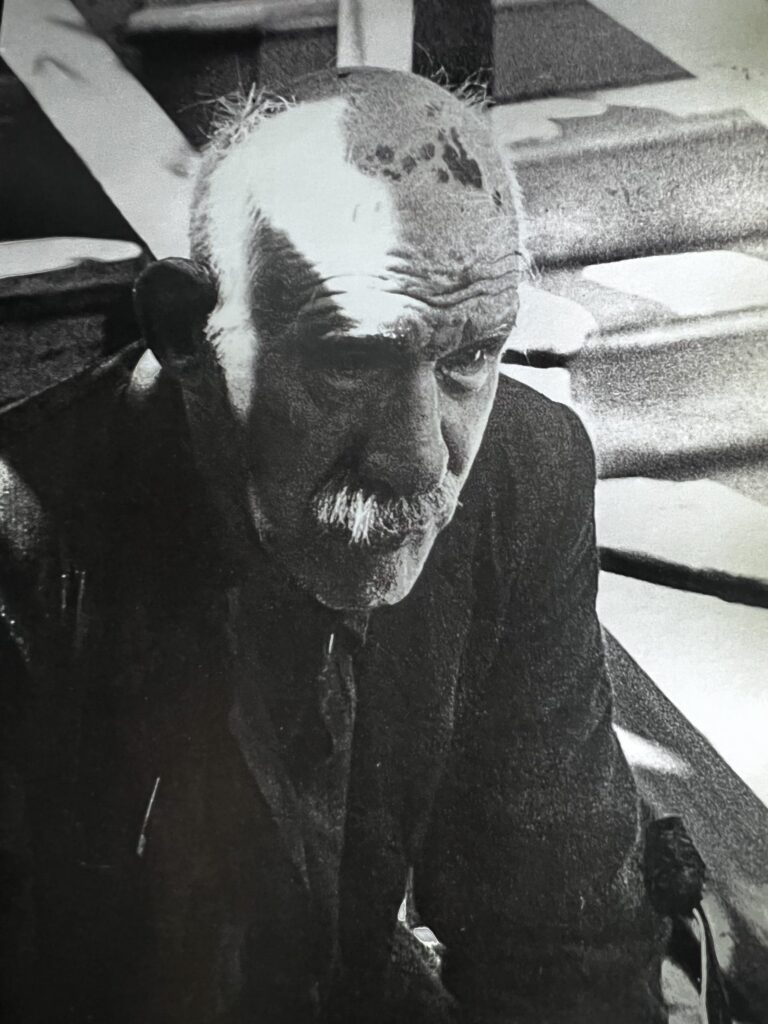
Henry Darger, Outsider Artist
Darger’s work is, without question, disturbing. The imagery that floods his pages—battles, mutilations, child martyrs—would most certainly spark outrage and cancellation if it emerged today.
And yet, beneath the brutality, there’s something sublime, something ethereal. His world—handmade in isolation, stitched together from scraps of popular culture and private mythology—demands recognition, not dismissal.
Artists whose mental anguish fuels their creative expression is particularly fascinating. Darger took isolation, loneliness, depression, and transformed them into something strangely beautiful and undeniably meaningful—work that resonates because it speaks to some private parts of ourselves that we don’t want anyone to see. His story reads like that of an antihero: deeply flawed, possibly dangerous, but somehow, inexplicably, he draws you into his world.
Enigmatic Recluse
Henry Darger (1892–1973) is often cited as one of America’s most enigmatic outsider artists—a recluse who spent most of his adult life in a small room in Chicago, working as a hospital janitor while secretly producing a colossal body of work. Born in Chicago, Darger’s early life was marked by tragedy and abandonment. His mother died when he was just four years old, and he was placed in a Catholic boys’ home when his father, disabled and unable to care for him, entered a home for the aged. Labeled as “feeble-minded” and later institutionalized at the Illinois Asylum for Feeble-Minded Children, Darger endured years of hardship before escaping in his teens and returning to Chicago to live in near-total isolation.
Darger’s magnum opus, The Story of the Vivian Girls, in What is Known as the Realms of the Unreal, of the Glandeco-Angelinian War Storm, Caused by the Child Slave Rebellion—often referred to simply as In the Realms of the Unreal—spans over 15,000 pages and is illustrated by hundreds of large-scale, double-sided watercolor paintings and collages. This private mythology was only discovered after his death, when his landlords Nathan and Kiyoko Lerner began clearing his room.
Controversies
Darger’s work has generated both fascination and discomfort, particularly for its violent, often brutal imagery juxtaposed with innocent child protagonists—the Vivian Girls. His paintings depict children, particularly young girls, engaged in fantastical wars of resistance against sadistic adult oppressors. These scenes are graphically violent, featuring dismemberments, strangulations, and crucifixions. Further controversy stems from Darger’s frequent depiction of nude or semi-nude girls, often with male genitalia—a detail that has provoked extensive debate among scholars and critics.